Learn everything you need to know to ace your Full Stack Development interview from FAANG+ engineers. This course has been meticulously curated by experts to help you put your best foot forward.
Students who chose to uplevel with IK got placed at
Pratik Agarwal
Software Development Engineer ll
Suat Mercan
Senior Software Engineer
Anshul Bansal
Software Engineer
Kishore Periassamy
Software Development Engineer
Vinayak Prabhu
System Development Engineer
Kelsi Lakey
Software Engineer
Shrey Shrivastava
Software Development Engineer ll
Aniruddha Tekade
Senior Software Engineer
21,000+
Tech professionals trained
$1.28M
Highest offer received by an IK alum
53%
Average salary hike received by alums
Best suited for
Full Stack Engineers/Developers looking to transition to tier-1 companies
Software Engineers/Developers looking to transition to tier-1 companies
Why choose this course?
Program designed by FAANG+ leads
Covering data structures, algorithms, interview-relevant topics, and career coaching
Individualized teaching and 1:1 help
Technical coaching, homework assistance, solutions discussion, and individual session
Personalized feedback
Constructive, structured, and actionable insights for improved interview performance
Personalized feedback
Constructive, structured, and actionable insights for improved interview performance
Career skills development
Resume building, LinkedIn profile optimization, personal branding, and live behavioral workshops
50% Money-Back Guarantee*
If you do well in our course but still don't land a domain-relevant job within the post-program support period, we'll refund 50% of the tuition you paid for the course.*
Our highly experienced instructors are active hiring managers and employees at FAANG+companies and know exactly what it takes to ace tech and managerial interviews.
Quazie Kwaselow
Senior Software Engineer
15+ years experience
A typical week at Interview Kickstart
This is how we structure and organize your interview prep. Our learners devote 10 to 12 hours per week to this course.
Thu
Get Foundational content
Get high-quality videos and course material for next week’s topics
Covers introduction to fundamentals, interview-relevant topics, and case studies
Attend timed test and review session
1-hour timed test covering essential interview questions on the current week's topics
1-hour test review session to discuss the test solution and other best practices
Sun
Attend online live sessions
Attend 4-5 hours long live sessions covering interview-relevant Full Stack concepts
A FAANG+ instructor will lead a discussion on a wide range of interview problems, open-ended design questions, and how to approach them
Mon-Wed
Practice problems & case studies
Apply the concepts taught in live sessions to solve assignment questions
Discuss the solutions of interview-oriented assignment problems in the live class
Live doubt-solving with FAANG+ Full Stack instructors
Every day
1:1 access to instructors
Personalized coaching from FAANG+ Full Stack instructors
Individualized and detailed attention to your questions
Solution walkthroughs
Full Stack Development Course details and Curriculum
Data Structures and Algorithms (Coding)
5 weeks
5 live classes
1
Sorting
Introduction to Sorting
Basics of Asymptotic Analysis and Worst Case & Average Case Analysis
Common Recursion- and Backtracking-related coding interview problems
3
Trees
Dictionaries & Sets, Hash Tables
Modeling data as Binary Trees and Binary Search Tree and performing different operations over them
Tree Traversals and Constructions
BFS Coding Patterns
DFS Coding Patterns
Tree Construction from its traversals
Common Trees-related coding interview problems
4
Graphs
Overview of Graphs
Problem definition of the 7 Bridges of Konigsberg and its connection with Graph theory
What is a Graph, and when do you model a problem as a Graph?
How to store a Graph in memory (Adjacency Lists, Adjacency Matrices, Adjacency Maps)
Graphs traversal: BFS and DFS, BFS Tree, DFS stack-based implementation
A general template to solve any problems modeled as Graphs
Graphs in Interviews
Common Graphs-related coding interview problems
5
Dynamic Programming
Dynamic Programming introduction
Modeling problems as recursive mathematical functions
Detecting overlapping subproblems
Top-down Memorization
Bottom-up Tabulation
Optimizing Bottom-up Tabulation
Common DP-related coding interview problems
System Design
3 weeks
3 live classes
1
Online Processing Systems
The client-server model of Online processing
Top-down steps for system design interview
Depth and breadth analysis
Cryptographic hash function
Network Protocols, Web Server, Hash Index
Scaling
Performance Metrics of a Scalable System
SLOs and SLAs
Proxy: Reverse and Forward
Load balancing
CAP Theorem
Content Distribution Networks
Cache
Sharding
Consistent Hashing
Storage
Case Studies: URL Shortener, Instagram, Uber, Twitter, Messaging/Chat Services
2
Batch Processing Systems
Inverted Index
External Sort Merge
K-way External Sort-Merge
Distributed File System
Map-reduce Framework
Distributed Sorting
Case Studies: Search Engine, Graph Processor, Typeahead Suggestions, Recommendation Systems
3
Stream Processing Systems
Case Studies: on APM, Social Connections, Netflix, Google Maps, Trending Topics, YouTube
Full Stack Domain
5 weeks
5 live classes
1
Databases
Frequently asked interview questions on databases for various use cases; social media platform – search, user connections, user feeds, ads, payments; how to handle peak hours?
Design an e-commerce data warehouse to efficiently compute, store and retrieve live metrics at various frequencies
Design a database solution for a web crawler that scrapes the product and pricing information from a competitor’s e-commerce website
Design a schema for Apple Music
Deep dive into database internals (transactions, indexes, and performance)
Explore Cloud Database Monitoring Tools: Monitoring database health and performance, scale performance via sharding
Comprehensive coverage of clarifying questions to ask while doing the requirement analysis and scope fencing during the design phase of a database
2
API Design and Implementation
Design an API for an image-sharing application: Outline which response codes you would use for certain situations on each endpoint
How to identify which user is accessing our API? Different ways of identifying a user from an API OAuth, Passwordless authentication, Multi-factor authentication
How to prevent man-in-the-middle attacks or session replays or cookie stealing/replays?
Encryption: How much is too much? Enforcing HTTPs
Design an API for Kick News, a discussion forum like Reddit or Hacker News – architecting, documenting, and testing REST APIs
Case study on moderation tools – When to use each authentication method and types of authorization
Call multiple endpoints and join the data on the client-side or implement infinite scrolling using GraphQL
Implement KickChat, a live chat feature – reacting to server events with polling and webhooks
How to test an API for security threats? Understanding the threats and then working on steps to prevent security threats: XSS, CSRF, SQL injection, input sanitization
3
Cloud Infrastructure
Evaluating cloud-native solutions for cost optimization; Economics of cloud and serverless computing
Fundamental questions on Key/Value datastores vs. RDBMS
Design a video transcoding service using a hybrid cloud architecture
Common problems in cloud-native/serverless systems and how to mitigate them? – Issues with database connections, scaling, and the hug of death
Interesting follow-up questions on system monitoring and alerts
How to fix a broken Lambda function?
Best practices and principles to be followed to meet the FAANG+ bar – DevOps, Infrastructure as Code
4
JavaScript and Web Development
Design an advertising API using JavaScript
Application logic using function expression or in-line expression
Popular FAANG+ interview question on re-writing the promise chain as async/await style code
How would you indicate that a piece of JavaScript code should only be used for a particular type of variable?
Using TypeScript to reduce code ambiguity, and in combination with other frameworks
Make critical design decisions. Manage external dependencies using yarn or an external package
Develop a Twitter-like homepage, with infinite scrolling – a popular FAANG+ interview question
How information may be passed down to child components using ‘props’
Approaches towards dynamically updating web pages – a popular interview skill
Questions on using iFrames and web components to incorporate external content
Incorporating good authorization and security policies for users
Demo of an OAuth integration, using the Google Drive API
5
UI System Design
Design a custom control component <SearchBox /> by extending existing controls
Design a portable UI control that provides a secure and compliant way to capture a payment method – embedding the payment method form in a web application
Develop a component-based design system to avoid duplicating development efforts – using Storybook.js to support the component library pattern
Transform state management from a non-framework model to a framework-specific model
How to think, act, and articulate like a front-end architect and tech lead emitting senior+ signals in system design interviews using methodical and structured interview strategy
Evaluate options, perform trade-offs, and analyze the business impact of modern web development frameworks
Manage the state of a UI application – A demonstration of how to approach programming questions in the UI system design domain
Design a common components library such as Bootstrap
Design a UI component SDK such as Stripe checkout SDK – A common theme in UI system design interviews
Industry trends within front-end engineering and surrounding domains (AI/ML)
Career Session Orientation
3 weeks
3 live classes
1
Interview Preparation
Interview Questions
Interview Strategy
Behavioral Coaching
2
Resume & LinkedIn Masterclass
3
Salary Negotiation Masterclass
Support Period
6 months
1
15 mock interviews
2
Take classes you missed/retake classes/tests
3
Self-paced content on additional topics for Data Structures and Algorithms
UpLevel will be your all-in-one learning platform to get you FAANG-ready, with 10,000+ interview questions, timed tests, videos, mock interviews suite, and more.
Mock interviews suite
On-demand timed tests
In-browser online judge
10,000 interview questions
100,000 hours of video explanations
Class schedules & activity alerts
Real-time progress update
11 programming languages
Get upto 15 mock interviews with
hiring managers
What makes our mock Interviews the best:
Hiring managers from Tier-1 companies like Google & Apple
Interview with the best. No one will prepare you better!
Domain-specific Interviews
Practice for your target domain - Full Stack
Detailed personalized feedback
Identify and work on your improvement areas
Transparent, non-anonymous interviews
Get the most realistic experience possible
More about mock interviews
1. Flexible schedule
Pick timings convenient to you
4. Technical and behavioral interviews
Uplevel your technical and behavioral interview skills
2. Remote interview experience
Mirrors the current format of remote interviews
5. Level-specific interviews
Because an L4 at Google can be quite different from an E7 at Meta
3. Feedback documentation
All the feedback you’ve ever wanted, recorded and documented
6. Interviewer of your choice
Choose based on domain
Career impact
Our students land high-paying and rewarding offers from the biggest tech companies, including Facebook, Google, Microsoft, Apple, Amazon, Tesla, and Netflix.
Siddharth Mondal
Works at:
Best course I would say for student of CSE or IT and professional. It will be more fruitful to me if I found this before 16 years when I was student. After this course anyone can be eligible/prepaired for FAANG or FAANG like companies. Contents are very good and explained everything nicely. This is my honest review. Anyone who is thinking about product based company, just take it, surely will not regret.
Sayan Banerjee
Works at:
IK is great place to set your foundation not just for big tech interviews but more so for being better engineer. Expert insights they bring in shape your ideas of working with inspiring/brightest minds in tech world. Customer service is prompt and on-time in resolving your request every single time so far. The courses are extensive and its rewarding for ppl who ready to work their sweat off consistently .
Kajal Chatterjee
Placed at:
I completed the Interview Kickstart Full stack program and currently pursuing Advance Gen AI program, and overall, I'm happy with the experience. The program is well-structured and targets the key areas needed for technical interviews, including data structures, algorithms, and system design. The instructors are knowledgeable, and the mock interviews provided invaluable practice and feedback. It prepares you for interviews within a reasonable time frame. You can retake the course and attend doubt-clearing sessions, which is great for reinforcing what you've learned.
Garima Pandey
Works at:
Resources are really helpful,
They have been so cooperative and helpful during the period of my interview prep and also after i faced a layoff! They helped me with resources and guidance! Truly appreciate everything for keeping yourself motivated and prepared for any situation !
Rosalin Dash
Works at:
I greatly appreciate and enjoy the content designed for Full Stack Developers. It fosters a way of thinking that I initially lacked when I began working with a startup.
Thank you for helping me develop a mindset that balances technical expertise with business considerations. This has enhanced my approach as a technical developer, enabling me to focus on both technical solutions and business revenue, rather than simply completing tasks to meet business needs.
My sincere recommendation is to follow the material as suggested by the team and avoid procrastinating the process.
How to enroll for the Full Stack Development Interview course?
Learn more about Interview Kickstart and the Data Science course by joining the free webinar hosted by Ryan Valles, co-founder of Interview Kickstart
A Free Guide to Kickstart Your Back-End Engineering Career at FAANG+
From the interview process and career path to interview questions and salary details — learn everything you need to know about Back-End Engineering careers at top tech companies.
What to Expect at Full Stack Development Interviews?
Initial technical screening: This usually involves a coding round and a discussion of your past Full Stack projects. While discussing projects, conceptual questions on the Full Stack domain, frameworks used, etc., are asked. You can also expect a 90-minutes long online assessment of your programming skills consisting of three coding challenges similar to Leetcode. In each challenge, you will be tested on Data Structures and Algorithms. It is important that you write compiling code and pass the majority of the test cases. The Full Stack interview questions on coding are typically at an easy/medium level on Leetcode.
On-site interview: It usually has 4-6 rounds, including one-on-one interviews and panel discussions. You can expect these rounds:
1
2-3 coding rounds:
Depending on the total years of experience, you will go through 2-3 coding (DSA-based) rounds. These rounds will have coding challenges to test your knowledge of Data Structures, Algorithms, and OOP. During the problem-solving stage, you will be asked about test cases, time/space complexity, and ways to improve the solution. Using an online coding practice website like Leetcode to prepare for these interview questions on tech programming can be extremely beneficial.
2
Full Stack/Web Fundamentals round:
Test for knowledge of Full Stack concepts. You’ll be asked to solve problems for different scenarios. This could be integrating with an existing API or looking for a bug in an existing codebase.
3
System design round:
For Full Stack roles at Tier-1 companies, there will usually either be a front-end or back-end system design round. You may be allowed to choose depending on the role you’re applying for.
Scalable system design round: General scalable architecture system design questions. This usually involves designing a scalable back-end service with cloud architecture.
Full Stack system design round: The solution for the design problem is evaluated on performance, accessibility, and modularity. You may also be asked to develop certain features from scratch; a strong understanding of your choice of frameworks will come in handy here. This can be designing a UI that takes in data from an API and modifies it to display to the user.
4
Behavioral round:
This round focuses on criteria like leadership and collaboration skills. You can expect questions related to job experience, discussions on past projects, and open-ended questions to gauge whether you’re a “good fit.”
Full Stack Developer Interview Questions on Coding
As a Full Stack developer, a lot of your time and effort will go into mastering Data Structures and Algorithms. Excellence and skill in coding are absolutely essential as that is most of your job. While there are other factors that contribute to the hiring call, you simply can’t be hired if you don’t clear coding rounds. You should have experience with these Full Stack developer interview questions (some of these are interview questions for senior Full Stack engineers):
Domain-Specific Full Stack Developer Interview Questions
Let us now look at some domain-specific questions asked in Full stack interviews. See if you can answer these Full Stack developer interview questions:
What are the latest trends in Full Stack Web Development?
What are some Stack Developer tools that you’ve worked with?
Explain DevOps, Pair Programming, and data attributes.
Explain Long Polling.
What is an Application server, and what is a RESTful API?
What is Event Bubbling and Capturing in JavaScript?
Distinguish between Server-side Scripting and Client-side Scripting.
How can you enhance your website load time and performance?
Explain the difference between Normalization and Denormalization.
What is Callback hell, and how to fix it?
State the success factors for successive integration.
What is your favorite coding language, and why?
What is the most important quality in a Full Stack developer?
What is the most important quality in a Full Stack developer?
How to prevent a bot from scraping a publicly accessible API?
State the differences between REST and GraphQL.
Explain referential transparency in functional programming.
Explain the architectural designs primarily used to design applications.
How can you share code between files?
What is the difference between Composition and Inheritance? Which would you use and why?
How can we enhance the scalability and efficiency of a website?
Explain multithreading and continuous integration.
3
Full Stack Developer Interview Questions on Behavioral Skills
Behavioral interview questions serve to assess cultural fit, communication skills, and leadership qualities. Try answering these Full Stack developer interview questions and see if your answers align with the culture and values of your target company:
Tell us about a time when you received criticism about your work and how you handled it.
If you have to deliver negative feedback to members of your development team, how would you do it?
Tell me about your favorite development project to date and what it was like from start to finish.
Tell me about the largest web application you have ever worked on. What coding were you responsible for?
What’s your preferred type of development environment?
What do you think contributes to a successful project?
How do you keep up with the latest technologies and trends?
Tell me about a time when you had to work with someone difficult. How did you handle it?
What is the most difficult change you’ve encountered in your career?
How do you handle situations where there is a lot of tension between you and a colleague?
Full Stack Developer Career
Let’s take a look at the Full Stack developer role in more detail now. It’s important to have clarity on the role requirements, levels and career roadmap, salary, and interview processes associated with the Full Stack developer role. It will help you decide if the Full Stack developer is the right role for you.
1
Full stack engineer/developer job descriptions include both front-end and back-end related responsibilities
Front-end related tasks in Full Stack developer jobs often include:
Developing new user-facing features.
Optimizing web pages for maximum speed and scalability.
Creating efficient and reusable front-end systems/libraries that drive complex web applications.
Collaborating with product designers, product managers, and software engineers to deliver compelling user-facing products.
Identifying and resolving performance and scalability issues.
Back-end related tasks in Full Stack software engineer jobs often include:
Designing and implementing APIs & business logic.
Designing and coding for databases.
Optimizing the back-end logic.
Creating efficient and reusable Micro-services.
Collaborating with product designers, product managers, and software engineers to deliver compelling products.
Identifying and resolving performance and scalability issues.
2
Full Stack Developer Career Roadmap
In a FAANG+ company, the career progression for the Full Stack developer role is:
SWE I / SWE II – Web Development (Full Stack) → SWE III – Web Development (Full Stack) → Senior SWE – Web Development (Full Stack) → Staff SWE – Web Development (Full Stack) or Tech Lead/EM → Senior Staff SWE or EM/Director → Principal Engineer or Director/VP
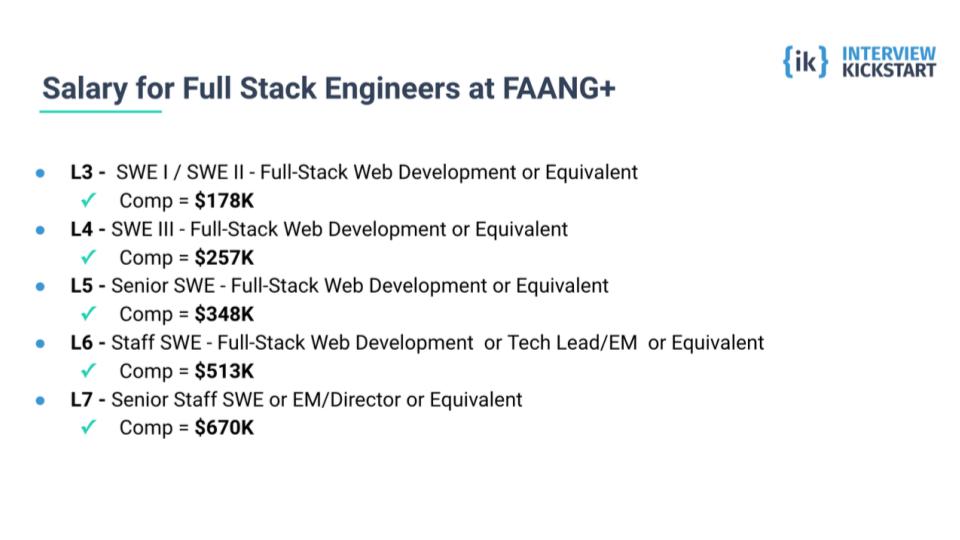
Full Stack Developer Salary and Levels at FAANG
Companies use levels to signify the increase in experience, knowledge, and responsibilities associated with the job description.
Generally, Full Stack software developers are divided into the following levels at FAANG+:
Unlike other FAANG+ companies, there is only one level on the ladder of progression for software engineers. The company strictly hires only experienced employees; thus, the Netflix Senior Software Engineer position is the only level.
Salary Details of Full Stack Developer at Other Tier-1 Companies
Like for every role, a Full Stack Engineer’s salary varies based on experience and responsibilities to ensure that a senior Full Stack software engineer’s salary is aligned with the value they are adding. Let’s take a quick look at how the Full Stack software engineer’s salary varies with the job levels.
You can learn more about more related topics on our companies page.
FAQs on Full Stack Development Interview Course
1
What does a Full Stack engineer/developer do?
Full stack developers are highly skilled in front-end and back-end technologies. They code for both front-end and back-end and aim to do so in low turnaround time, with zero bugs. They must also have an understanding of the whole picture to create a seamless experience for the user.
2
What skills are needed to be successful in the Full Stack domain?
As a Full Stack developer, you need to know JavaScript, CSS, HTML, modern JavaScript frameworks like React/Angular, back-end tools, and technologies like Java/Spring, Python/Django, Node.js, MySQL, MongoDB, REST APIs, etc. A good understanding of web performance and workings of browsers and DOM is required. Successful Full Stack developers also tend to have experience with unit, integration, end-to-end testing and experience working cross-functionally with product and design.
3
Does Full Stack include DevOps?
4
Is Full Stack Development considered same as Software Engineering?
Yes. Full Stack web development is a subset of software engineering and includes using both front-end and back-end technologies. In contrast, front-end developers focus only on front-end technologies, and back-end developers focus only on back-end technologies.
5
Why are companies looking for Full Stack developers?
A Full Stack developer is highly skilled in both back-end and front-end development technologies. Full Stack developers are indispensable to the development of software applications and solutions. Their absence would make the development process much slower. Having people who know both front-end and back-end development helps make sure everything runs smoothly.
How to enroll for the Full Stack Development Interview course?
Learn more about Interview Kickstart and the Full Stack Development interview course by joining the free webinar hosted by Ryan Valles, co-founder of Interview Kickstart.