Designed and taught by FAANG+ engineers, this course will give you a foolproof preparation strategy to crack the toughest interviews at FAANG and Tier-1 companies.
Students who chose to uplevel with IK got placed at
Safir Merchant
SWE, Machine Learning
Jameson Merkow
Principal AI Engineer
Sayan Banerjee
Data Scientist II
Mike Kane
Lead Data Engineer, Analytics
Akshay Lodha
Data Engineering & Analytics
Anju Mercian
Data Engineering Consultant
Alokkumar Roy
Data Engineer
Siva Karthik Gade
SDE, Machine Learning
Sai Marapa Reddy
SWE, Machine Learning
21,000+
Tech professionals trained
$1.28M
Highest offer received by an IK alum
53%
Average salary hike received by alums
Best suited for
Current or former ML Engineers/Specialists/Generalists
Software Engineers working on ML Systems
Data Engineers/Data Scientists/ Research Engineers who want to transition to ML Engineer roles
Why choose this course?
Program designed by FAANG+ leads
Covering data structures, algorithms, interview-relevant topics, and career coaching
Individualized teaching and 1:1 help
Technical coaching, homework assistance, solutions discussion, and individual session
Mock interviews with Silicon Valley engineers
Live interview practice in real-life simulated environments with FAANG and top-tier interviewers
Personalized feedback
Constructive, structured, and actionable insights for improved interview performance
Career skills development
Resume building, LinkedIn profile optimization, personal branding, and live behavioral workshops
50% Money-Back Guarantee*
If you do well in our course but still don't land a domain-relevant job within the post-program support period, we'll refund 50% of the tuition you paid for the course.*
Our highly experienced instructors are active hiring managers and employees at FAANG+ companies and know exactly what it takes to ace tech and managerial interviews.
Matt Nickens
Manager, Data Science
10+ years experience
Jameson Merkow
Principal AI Engineer
11+ years experience
Christian Monson
Machine Learning Scientist
9+ years experience
Alireza Dirafzoon
Research Engineer
7+ years experience
A typical week at Interview Kickstart
This is how we make your interview prep structured and organized. Our learners spend 10-12 hours each week on this course.
Thu
Attend online live sessions
Get high-quality videos and course material that introduce the fundamentals and intuition behind the topics covered in the upcoming week's live class
Discusses interview-relevant questions and insights
Assignment review session
Discuss the coding or system design solutions and practice answering frameworks in class
Interact with Tier-1 instructors to get insights into your solution, along with a model solution for each problem covered
Sun
Attend online live sessions
Attend 4-hour interactive sessions covering a new ML System Design problem every week
Get interview-relevant insights into the System Design problem from a Tier-1 tech instructor
Learn how you can approach the problem using a comprehensive answering Framework
Mon-Wed
Coding assignments
Solve specially curated coding assignments where you implement the learnings from the week's module
System design assignments
Apply the framework taught in the live class to solve a new Scalable/ML System Design problem
Discuss the solution in a mock group session with a Tier-1 instructor
Technical coaching sessions
Clear technical or interview-specific doubts (if any) with FAANG+ instructors.
Every day
1:1 access to instructors
Personalized coaching from FAANG+ instructors
Individualized and detailed attention to your questions
Solution walkthroughs
Machine Learning Interview Course Curriculum
Data structures and Algorithms
5 weeks
5 live classes
1
Sorting
Introduction to Sorting
Basics of Asymptotic Analysis and Worst Case & Average Case Analysis
Common recursion- and backtracking-related coding interview problems
3
Trees
Dictionaries & Sets, Hash Tables
Modeling data as Binary Trees and Binary Search Tree and performing different operations over them
Tree Traversals and Constructions
BFS Coding Patterns
DFS Coding Patterns
Tree Construction from its traversals
Common trees-related coding interview problems
4
Graphs
Overview of Graphs
Problem definition of the 7 Bridges of Konigsberg and its connection with Graph theory
What is a graph, and when do you model a problem as a Graph?
How to store a Graph in memory (Adjacency Lists, Adjacency Matrices, Adjacency Maps)
Graphs traversal: BFS and DFS, BFS Tree, DFS stack-based implementation
A general template to solve any problems modeled as Graphs
Graphs in Interviews
Common graphs-related coding interview problems
5
Dynamic Programming
Dynamic Programming Introduction
Modeling problems as recursive mathematical functions
Detecting overlapping subproblems
Top-down Memorization
Bottom-up Tabulation
Optimizing Bottom-up Tabulation
Common DP-related coding interview problems
System Design
3 weeks
3 live classes
1
Online Processing Systems
The client-server model of Online processing
Top-down steps for system design interview
Depth and breadth analysis
Cryptographic hash function
Network Protocols, Web Server, Hash Index
Scaling
Performance Metrics of a Scalable System
SLOs and SLAs
Proxy: Reverse and Forward
Load balancing
CAP Theorem
Content Distribution Networks
Cache
Sharding
Consistent Hashing
Storage
Case Studies: URL Shortener, Instagram, Uber, Twitter, Messaging/Chat Services
2
Batch Processing Systems
Inverted Index
External Sort Merge
K-way External Sort-Merge
Distributed File System
Map-reduce Framework
Distributed Sorting
Case Studies: Search Engine, Graph Processor, Typeahead Suggestions, Recommendation Systems
3
Stream Processing Systems
Case Studies: on APM, Social Connections, Netflix, Google Maps, Trending Topics, YouTube
Machine Learning Masterclass
5 weeks
5 live classes
1
Supervised Learning I - Rank Relevant Search Results
Deep dive into the design of a search relevance system like Google Search (a popular FAANG interview question).
Comprehensive coverage of document indexing, retrieval, similarity scoring, filtering, and ranking.
Model training: Build a ranking model using Linear or Logistic Regression. Which method performs better for ranking a search result?
Online testing scenarios: How to run an A/B test to evaluate if new features improve the model? Which metrics to use?
Interesting follow-up questions: How do you offset the lack of negative samples for training without adding new data? Does a “no-click” impression correspond to a negative label?
Non-trivial questions on fundamental topics: Does L1/L2 regularization always increase model performance? Which metric is best for evaluating models on imbalanced datasets? When is the k-nearest neighbors algorithm better than logistic regression for classification analysis?
1
ML Model Lifecycle and MLOps
Introduction to Sorting
Basics of Asymptotic Analysis and Worst Case & Average Case Analysis
Supervised Learning II - Design a YouTube Video Recommendation System
Build a video recommendation system for YouTube users. Answer questions like: How to maximize user engagement? How to recommend new content to users?
Best practices of feature engineering, data collection, feature encoding, and video embeddings.
In-depth coverage of content-based and collaborative filtering, matrix factorization, and maximizing the optimum objective function.
Triage critical concerns when building a recommender system: How do you account for positional bias when ranking a video? Strategies to ensure the freshness, diversity, and fairness of the recommendations.
Non-trivial questions on fundamental topics: How do you train a State Vector Machine (SVM) on non-linear data? Why only a subset of features for each tree in a random forest? What is the bias-variance tradeoff, and how can ensemble learning techniques like bagging and boosting address it?
3
Unsupervised Learning - Detect Fraud Transactions for Airbnb
Design an anomaly detection system for Airbnb transactions.
Comprehensive coverage of fraud detection techniques: Reputation lists, rules-based detection, classification vs. clustering.
A top-down approach to building a high-level architecture: User and agent data, feature aggregation, model dashboard, data embedding
Difficult follow-up questions: How to speed up computation time for unsupervised anomaly detection? Strategies to combine clustering with supervised learning techniques.
Non-trivial questions on fundamental topics: What could be the possible reason(s) for producing two different dendrograms using an agglomerative clustering algorithm for the same dataset? Dimensionality reduction with computational power constraints – t-SNE vs. PCA?
4
Deep Learning I - Detect and Process Objects in a Scene
Design an Image Processing system for Object Detection (frequently asked in FAANG ML interviews).
Deep-dive into object detection workflow: Preprocessing, Candidate Generation and Selection, Unprocessing, and Postprocessing.
Multiple strategies to build the object detector: Convolutional Networks, Region-based CNNs, You Only Look Once (YOLO), Transfer Learning, etc.
Interview-relevant strategies: What questions to ask an interviewer? How to structure your solution?
Address possible follow-up questions: How do you detect and replace multiple instances of the same object from an image? What if direct ground truth labels are absent?
Non-trivial questions on fundamental topics: Using dropout layers in a small neural network. How to combat vanishing and exploding gradients in CNNs? What is the best learning rate optimizer for improving model performance on large datasets?
5
Deep Learning II - Build a Tech Support Chatbot
Design an intelligent Discord bot to provide Technical Support for a software Bootcamp.
In-depth coverage of functional and non-functional requirements: Scale and latency estimation, throughput, passive feedback mechanisms.
Knowledge base creation: Embedding, Sharding, Caching, etc. Strategies to expand the knowledge base.
Challenges in bot design: How to deal with a cold-start with no knowledge base? How do you generate answers to previously unasked questions?
Logical follow-up questions: How to handle increasing complexity and scale? How can we introduce a continuous learning mechanism in the chatbot design?
Non-trivial questions on fundamental topics: Which type of word embedding method is more suitable for measuring context similarity? Why is “Exploding Gradients” a problem in the context of RNNs? When should we not use a bi-directional LSTM?
$
Additional Topics:
A comprehensive step-by-step approach to ML System Design interview rounds
How is ML System Design different from General System Design?
What does an interviewer expect from this round?
How do you breakdown and answer open-ended questions like:
Modern ML Architectures
Why do we learn a distribution instead of a deterministic model during encoding? How do we introduce variability in a variable autoencoder?
What is the difference between Discriminative and Generative models?
Reinforcement Learning
How do you evaluate the state and responses of an agent?
How is value iteration different from policy iteration? What problem does it address?
UpLevel will be your all-in-one learning platform to get you FAANG-ready, with 10,000+ interview questions, timed tests, videos, mock interviews suite, and more.
Mock interviews suite
On-demand timed tests
In-browser online judge
10,000 interview questions
100,000 hours of video explanations
Class schedules & activity alerts
Real-time progress update
11 programming languages
Get upto 15 mock interviews with
hiring managers
What makes our mock Interviews the best:
Hiring managers from Tier-1 companies like Google & Apple
Interview with the best. No one will prepare you better!
Domain-specific interviews
Practice for your target domain - Machine Learning
Detailed personalized feedback
Identify and work on your improvement areas
Transparent, non-anonymous interviews
Get the most realistic experience possible
More about mock interviews
1. Flexible schedule
Pick timings convenient to you
4. Technical and behavioral interviews
Uplevel your technical and behavioral interview skills
2. Remote interview experience
Mirrors the current format of remote interviews
5. Level-specific interviews
Because an L4 at Google can be quite different from an E7 at Meta
3. Feedback documentation
All the feedback you’ve ever wanted, recorded and documented
6. Interviewer of your choice
Choose based on domain
Career impact
Our engineers land high-paying and rewarding offers from the biggest tech companies, including Facebook, Google, Microsoft, Apple, Amazon, Tesla, and Netflix.
Sumanth
Works at:
Simply Awesome Comprehensive ML Course from IK I am a Backend Software Engineer who has taken the Uplevel Machine Learning course which unlike other programs is a very thorough and intense one year long course. The value, the students get out of this year long course is simply amazing as it is like a Master's Course which you do at a regular University. Thanks for coming up with such a course which is beneficial to all Engineers who want to up level themselves in AI&ML.
Arul
Works at:
Interview Kickstart (IK) offers valuable tech interview preparation with detailed technical modules, practical mock interviews, and excellent support. Mock Interviews: IK's mock interviews simulate real interview environments at top tech companies, providing immediate, actionable feedback. Technical Modules: The modules, especially in Data Structures & Algorithms and System Design, are well-constructed and taught by knowledgeable instructors with industry experience. Overall, IK refined my preparation for technical interviews, and I am grateful to the IK team.
Anup Bhatt
Works at:
Classes: I attended the live classes for asking doubts and professional interaction, it was really great. Mock Interviews: This is the main reason for spending on this product. You get FAANG(MAANG now) or equivalent level engineers and managers preparing you for actual interviews through proper simulation of real-world conditions
Support staff: In my experience, the support staff were quite prompt and got all my requests sorted by 24 to 48 hours turnaround time.
Discord/Alumni Groups: This is where the networking and extra stuff happens. Highly recommend this activity !
A Free Guide to Kickstart Your Machine Learning Career at FAANG+
From the interview process and career path to interview questions and salary details — learn everything you need to know about Machine Learning careers at top tech companies.
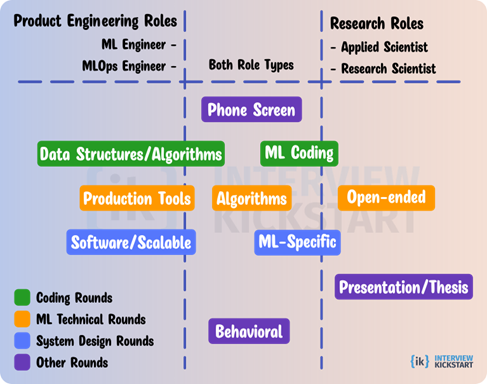
Typically, the Machine Learning interview process at FAANG+ and other Tier-1 companies include the following rounds:
Initial technical screening
Basic ML understanding, including a discussion on past ML projects
Coding problems
3-8 on-site rounds
1-2 coding rounds:
Coding problems on Data Structures and Algorithms
ML algorithm coding + project discussion
1-2 system design rounds:
Scalable/software design
ML Systems
1-3 ML technical rounds (ML breadth and depth understanding):
ML Algorithms
Deployment Tools and techniques
Behavioral round
Open-ended questions to gauge if you’re a “good fit” for the company
What to Expect at Machine Learning Engineer Interviews
1
Initial phone/technical screening round:
This can be a combination of basic ML understanding round/past projects or purely coding-based: Medium Hard LC questions. Some companies refuse to move forward if you fail the initial ML screen.
2
3-8 On-site rounds:
Coding round: This can be a mix of project discussion and coding
System design round: Mix of questions on how to design a general software system
ML system design round (1-2 rounds): For example, design a recommendation system for Netflix. For candidates having less than 3 years of experience, ML system design is often replaced by another core ML Understanding Round of medium to high difficulty
ML fundamental round: Familiarity with algorithms such as Linear/Logistic Regression, Decision Trees, SVM, Deep Neural Networks and optimization techniques, loss functions such as Gradient Descent, Cross-Entropy Loss, etc. These questions can vary based on the specific role and team you are applying for
Behavioral round: You can expect questions on your job experience and discussions on past projects along with open-ended questions to understand if you’re a good fit for the role.
For more specific information on the Machine Learning Engineer’s interview process at FAANG+ companies, check out:
Interview Process for Different Machine Learning-Related Roles
A typical ML Engineer interview consists of:
1-2 coding rounds – Usually, Data Structures and Algorithms based questions are asked, but some companies also ask you to code basic ML algorithms (Usually in Python)
1-2 system design rounds – One general system design round (like SDE profile) and another ML System design round
1 behavioral round — Questions regarding your past work experience will be asked to see if you’re a cultural fit
1-2 ML fundamentals rounds: These can cover areas such as:
Discussion on past projects in a related field
Understanding of various ML algorithms and their underlying principles
Discussion on challenges and tradeoffs related to each algorithm
A typical Applied Scientist interview consists of:
1 coding round – Usually includes questions on Data Structures and Algorithms, but some companies ask to code basic ML algorithms (Python)
1 ML system design round – Mainly focused on ML understanding (compared with the MLE round, where model production and deployment are equally important), i.e., identifying a suitable dataset for the problem, feature engineering, tradeoffs, sampling, etc.
1-2 ML Depth and Breadth rounds: Deep dive into ML fundamentals about their prior experience
1 behavioral round — Questions regarding your past work experience will be asked to see if you’re a cultural fit.
A typical Research Scientist interview consists of:
1 coding round – Usually Python library-based (Pytorch/Tensorflow) or LeetCode Easy in some companies.
1 ML problem-solving round – Identifying a suitable dataset for the problem, feature engineering, tradeoffs, experimentation design, how to establish a baseline, modifying current algorithms to suit the situation, etc.
1 presentation round – Present some research problem (from the Ph.D. thesis, previous work experience, or any new topic relevant to the interviewing team), followed by QnAs. Expected to have a firm grasp of Concepts and Advancements in the given problem to answer applied questions.
1-2 ML Depth and Breadth rounds – Deep dive into ML fundamentals about their prior experience. Expected to have proficiency in ML Algorithms from the mathematical to the application level.
1 behavioral round — Questions regarding your past work experience will be asked to see if you’re a cultural fit.
The interview process for the various Machine Learning positions is quite rigorous, so you need to be prepared accordingly. To get you started, we’ve compiled a list of the most frequently asked Machine Learning interview questions and segmented them into different categories.
1
Machine Learning Interview Questions on Coding
You are given some corrupted text with all the spaces removed. Implement an algorithm to recover the original text.
Given a sorted integer array, find the index of a given number’s first or last occurrence. If the element is not present in the array, report that as well.
Given: Two strings, A and B, of the same length n. Find: Whether it’s possible to cut both strings at a common point such that the first part of A and the second part of B form a palindrome.
Given a tree, write a function to return the sum of the max-sum path which goes through the root node.
Given an infinite chessboard, find the shortest distance for a knight to move from position A to position B.
Implement a k-means clustering algorithm with just NumPy and Python built-ins.
Given a filter and an image, implement a convolution. Follow up with a given stride length, padding, etc.
2
Machine Learning Interview Questions on System Design
Design an application for inventory data management.
Write a program to retrieve log data in an optimal way.
How would you design a function that schedules jobs on a rack of machines knowing that each job requires a certain amount of CPU & RAM, and each machine has different amounts of CPU & RAM?
Design a “Hey Siri” style trigger word detection system.
In-flight entertainment systems have a vast library of movies that users can enjoy during their journey. Design a system that recommends a set of movies to watch based on the user’s preferences and total flight time.
How would you detect fraud or predatory house listings on Airbnb?
3
Machine Learning interview Questions on ML Basics
Does the vanishing gradient problem occur closer to the beginning or end of the neural network training process?
Explain why XGBoost performs better than SVM.
How do you deal with imbalanced data?
When using sci kit-learn, do we need to scale our feature values when they vary greatly?
How would you select the value of “k” in a k-means algorithm?
What is the difference between the normal, soft-margin SVM and SVM with a linear kernel?
How would you detect spam emails? What is the best metric for this type of system: precision or recall?
What do you mean by a generative model?
Which methods can you use to summarize the content of 1000 tweets?
What are the different ways of preventing over-fitting in a deep neural network? Explain the intuition behind each.
4
Open-ended Machine Learning Interview Questions
According to you, which is the most valuable data in our business?
What are your thoughts on our current data process?
How can we use your Machine Learning skills to generate revenue?
How will you quantify the level of success of the projects you implement?
Pick any product or app that you really like and describe how you would improve it.
Machine Learning has changed the face of technology as we know it. Machine Learning adoption results in 3x faster execution and 5x faster decision-making. As a result, not only are ML engineer positions in high demand, with companies willing to pay top dollar for the right engineers, but the responsibilities for these roles have become significantly more diverse.
When a company hires ML engineers, it wants candidates who can contribute to innovations that will change the world.
1
Machine Learning Job Roles and Responsibilities
Machine Learning Engineers are highly skilled programmers who develop Machine Learning systems for business applications. They scale prototype models to large datasets, deploy them on the cloud or internally, and build end-to-end pipelines to continuously monitor the model performance.
The responsibilities of an ML Engineer differ from one company to the next and are frequently determined by the size of the company. In this blog, Machine Learning Engineering Roles — What’s the Best Fit for You, you can read about the differences between different ML roles and determine which is the best fit for you.
Even though the specific responsibilities of ML Engineers may vary considerably, their key day-to-day jobs may include all or a subset of the following:
Design and Develop
Identifying the specifications for a scalable Machine Learning model for a specific business requirement
Extracting critical insights from historical data by leveraging data-wrangling expertise
Analyzing the use cases of ML algorithms and ranking them by their success probability
Finding the best models to balance business requirements and architectural constraints
Designing the high-level architecture required to deploy a production scale model on a given platform
Developing Machine Learning models and tools on petabyte or larger scale datasets
Test
Identifying differences in data distribution that could affect model performance in real-world situations
Automating model training and evaluation processes
Addressing various bottlenecks in scaling ML models to real-time customers with minimum latency and high throughput
Collaborating with data scientists and engineers to scale prototype solutions and build extensible tools
Monitoring model performance on different datasets under different architectural constraints
Developing pipelines to process and store big data using Hadoop/Scala/Spark-like technologies
Deploy
Designing and implementing APIs, services that host these models, and integrating said services to various endpoints
Leveraging AWS (e.g., Sage Maker, Lambda, etc.), Azure, or Google Cloud Platform with other techniques (e.g., Spark, Python, Java, etc.) to deploy production class ML services
Building resilient and transparent end-to-end pipelines to monitor the quality and performance of Machine Learning models
Maintain
Maintaining a highly scalable data and model management infrastructure that supports cutting-edge research
Maintaining core system features, services, and engines
Reviewing existing code for accuracy and consistency with best practices and style guidelines
Contributing to documentation and educational content for knowledge transfer
Triaging and resolving production issues by analyzing the source and impact on architecture, operations, and delivery
Improve
Training and retraining ML systems and models as needed
Building a suitable product feature roadmap by collecting current and future requirements
Adapting existing algorithms to make use of parallelized or distributed processing systems (e.g., distributed clusters, multicore SMP, and GPU)
Building prototypes and A/B Test pipelines to evaluate algorithm improvements
You will work on more and more of the above tasks as you progress in your career as an ML Engineer. However, if you transition into a managerial role, you can also expect to:
Interact directly with customers to understand their requirements and drive changes to product features
Advise and collaborate with cross-functional teams, including researchers, data scientists, and data engineers, to improve architecture, design, and technical capabilities
Identify new products and opportunities for the company and influence the relevant stakeholders to prioritize their development
Develop and manage metrics, KPIs, and dashboards to improve team efficiency and ensure conformation to best practices
Understand industry-wide trends, and collaborate with industry experts to further organizational goals
Effectively communicate complex features & systems in detail
Mentor and support team members and accelerate their career growth
2
Machine Learning Job Requirements and Skills
A robust coding background with experience in infrastructure design and end-to-end ML model deployment
In-depth knowledge of various ML techniques, their tradeoffs, their advantages in terms of performance, and intuitive understanding of which technique fulfills the need of the hour
Awareness of the latest developments in ML/MLOPs and the ability to iteratively improve model performance
Qualifications Required to Become a Machine Learning Engineer
Basic Qualifications
Bachelor’s degree or Master’s degree in Computer Science or related field
Experience building large-scale machine-learning infrastructure
Experience with at least one modern language such as Java, C++, or C#, including object-oriented design
Hands-on experience deploying Machine Learning models in production
Experience with Machine Learning techniques such as pre-processing data, training, and evaluation of classification and regression models, and statistical evaluation of experimental data.
1+ years of experience contributing to new and current systems’ architecture and design (architecture, design patterns, reliability, and scaling)
Preferred Qualifications
Master’s degree in Computer Science or related field
Advanced knowledge of performance, scalability, enterprise system architecture, and engineering best practices
Academic and/or industry experience with one or more domains: computer vision, deep learning, Machine Learning, or large-scale distributed systems
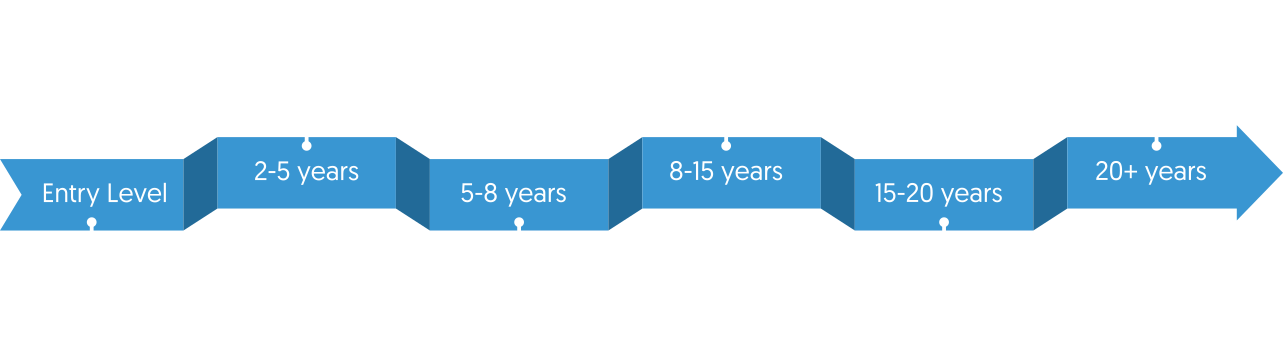
In a Tier-1 company, the typical career ladder for the ML role looks like this:
Machine Learning Engineer Salary and Levels at FAANG+ Companies
Before moving on to FAANG+ companies, here are the average salaries of ML engineers based on tenure and level in tech companies:
ML Engineer I / Entry Level (L3)
Years of experience: 0-2
Compensation: $190K+
ML Engineer II / ML Scientists (L4)
Years of experience: 2-5
Compensation: $260K+
Senior ML Engineers / Applied Scientists / Research Scientists (L5)
Years of experience: 5-8
Compensation: $360K+
Staff ML Engineers / Team Leads (L6)
Years of experience: 8-15
Compensation: $500K+
Principal ML Engineers / ML Directors (L7)
Years of experience: 15+
Compensation: $850K+
Facebook Machine Learning Engineer Salary
Machine Learning Engineer roles at Facebook are highly rewarding, both in terms of compensation as well as professional growth. The different levels of Machine Learning Engineers at Facebook are:
E3 (Associate ML Engineer): This is typically the level at which fresher Machine Learning Engineers or Software Engineers are hired.
E4: Those hired at this level should have 3-5 years of industry experience. However, new grads can also be hired at this level, provided they can demonstrate skill and expertise.
E5: ML Engineers hired at E5 have at least 5-8 years of industry experience as they are required to lead complex projects on their own. Also considered the “terminal” level before an ML Engineer moves into the management domain as E5 onwards, they perform more managerial responsibilities.
E6: Most ML Engineers working at this level have almost 8-15 years of experience.
E7: This tier is mostly for ML Directors and Principal ML Engineers with more than 15 years of experience.
Being one of the biggest tech companies in the world, Amazon offers lucrative compensation packages to ML engineers. Amazon has its own Machine Learning Engineer job levels. They are:
MLE I: Entry-level ML Engineers with less than 4 years of experience pursuing advanced degrees. They need to be skilled in at least one scripting language and familiar with SQL.
MLE II: Mid-level ML Engineers have 4-7 years of experience and may also have the title of ML Engineer II. At this level, ML Engineers usually have a Master’s degree with a good knowledge of coding.
MLE III: This level is for ML Engineers who have advanced degrees like Ph. Ds in Machine Learning, Natural Language Processing, etc., based on their area of specialization. The level includes several managerial positions as well.
Principal MLE: This level is for ML Engineers with 10+ years of experience. These employees have several management responsibilities and essentially run the teams.
Senior Principal MLE: These are highly experienced people who essentially are team heads with multiple teams working with them in a single or even multiple product categories.
The race to get a Machine Learning job at Apple is quite competitive as the company is renowned for building world-class innovative products. The typical entry-level Apple Machine Learning Engineer’s salary is $180k per year.
The company divides the ML Engineer roles into different levels:
ICT2: Apple’s entry-level position which usually attracts people with 0-1 year of experience. They need to have at least some knowledge of ML modeling with proficiency in Python.
ICT3: People hired at this level should have around 2-5 years of experience with demonstrated knowledge of ML model deployment. Master’s degree holders can usually start out at this level.
ICT4: This level is for people with 5-10 years of experience or a Ph.D. in a related field like Computer Science, Machine Learning, etc. Managerial positions also start at this level.
ICT5: Senior ML Engineers with 10+ years of experience are hired at this level. They are expected to manage their own teams within the organization or work with cross-functional teams.
ICT6: Highly experienced people with experience in managing multiple teams are usually hired at this level.
Unlike other companies such as Amazon and Apple, Netflix doesn’t have job levels. The company is known mostly for hiring only senior professionals with at least 4 years of experience. They have also started hiring new graduates for software engineer positions recently.
Here are the median salaries of a Software Engineer at Netflix working in the ML/AI domain:
Machine Learning Engineer at Netflix
Average compensation by level
Level name
Total
Base
Stock (/yr)
Bonus
New Grad Software Engineer
US$240K
US$180K
US$60K
$13K
Senior Software Engineer
US$675K
US$645K
US$30K
$13K
Google Machine Learning Engineer Salary
At the helm of today’s Machine Learning innovation is Google. So when the company sets out to hire Machine Learning engineers, you know they are looking for only the best of the best. The typical entry-level Google Machine Learning Engineer’s salary is $196K per year.
The different job levels at Google:
L3 (ML Engineer II): An entry-level position with 0-1 year of experience
L4 (ML Engineer III): Requires 2-5 years of experience
L5 (Senior ML Engineer): Requires over five years of experience
L6 (Staff ML Engineer): Requires 5-8 years of experience
L7 (Senior Staff ML Engineer): Requires over 8 years of experience
Machine Learning Engineer at Google
Average compensation by level
Level name
Total
Base
Stock (/yr)
Bonus
L3
US$196K
US$138K
US$40K
US$21K
L4
US$283K
US$169K
US$85K
US$29K
L5
US$364K
US$190K
US$134K
US$35K
L6
US$535K
US$232K
US$240K
US$53K
L7
US$730K
US$272K
US$375K
US$80K
Machine Learning Engineer Salaries at Other Tech Companies
Knowing the Machine Learning Engineer’s salary details for other tier-1 companies can help you evaluate your options better. We’ve curated the salaries associated with each of these companies at different levels:
Machine Learning Engineer at Tier-1 Companies
Average compensation by level
Company
Level Name
Total Compensation
Years of Experience
Adobe
Software Engineer 1
Software Engineer 2
Software Engineer 3
Software Engineer 4
Software Engineer 5
Software Engineer 5.5
US$200K
US$220K
US$245K
US$324K
US$430K
US$667K
0-1
1-2
2-5
5-8
8-10
10+
Airbnb
L3
L4
L5
US$266K
US$295K
US$447K
0-1
1-4
4-10
DoorDash
E3
E4
E5
US$200K
US$330K
US$380K
0-2
2-5
5+
IBM
Associate Engineer
Staff Engineer
Advisory Engineer
Senior Engineer
Senior Technical Staff
Member
Distinguished Engineer
US$100K
US$136K
US$160K
US$232K
US$270K
US$367K
0-1
1-3
3-8
8-12
12-16
16+
LinkedIn
Software Engineer
Senior Software
Engineer
Staff Software Engineer
Senior Staff Software
Engineer
US$250K
US$312K
US$522K
US$671K
0-3
3-8
8-13
13+
Microsoft
59, 60
61, 62
63, 64, 65
66, 67
68
US$170K
US$200K
US$320K
US$445K
US$700K
0-3
3-5
5-8
8-12
12+
Pinterest
L3
L4
L5
US$230K
US$285K
US$465K
0-2
2-3
3-8
Twitter
SWE I
SWE II
Senior SWE
Staff SWE
Senior Staff SWE
US$193K
US$255K
US$333K
US$590K
US$600K
0-1
1-3
3-6
6-10
10+
Uber
Software Engineer I
Software Engineer II
Senior Software Engineer
Staff Software Engineer
Senior Staff Software Engineer
US$164K
US$260K
US$450K
US$530K
US$800K
0-1
1-3
3-8
8-12
12+
Zillow
P2
P3
P4
P5
US$170K
US$240K
US$350K
US$505K
0-1
1-3
3-6
6+
You can learn more about more related topics on our companies page.
FAQs on Machine Learning Interview Course
1
What are the programming languages used in Machine Learning?
Machine Learning modeling is typically done in Python, which has excellent support from inbuilt libraries to do the same. R is another programming language used for experimentation purposes, but it’s not as widely used as Python. Some companies might also use MATLAB.
2
Is having a mathematics background a must for ML-related roles?
While it is not a must, having familiarity with concepts such as probability, integrals, differentiation, vectors, coordinate geometry, etc., can assist in understanding the idea behind several ML algorithms.
3
Do ML Engineers perform ML modeling/experimentations, or are they just concerned with the deployment part?
It depends on the role. Many companies expect MLEs to handle modeling, experimenting, and deployment parts. In contrast, other companies have data scientists to perform ML experiments and MLEs to translate those python ML models to binaries for deployment.
4
Is IK’s Machine Learning Interview Course just for professionals working as ML Engineers in non-FAANG+ companies?
No, this course is for everyone – FAANG or non-FAANG. If you have worked as an ML Engineer in any company, or you have relevant background in ML production and design, this course is for you. We will help you in all the preparation that you need for cracking the ML Engineer roles in any company.
5
I am working as a Data Scientist in my current company. Will this course help me transition into an ML Engineer role?
That depends. If you have some practical experience in deploying Machine Learning models on a production scale with working knowledge of platforms like AWS, Azure, or GCP, then this course can help you fill in the gaps required for an ML Engineer role. We will cover the relevant Data Structures and Coding, Scalable System Design, and ML System design concepts that you will need to crack the interviews. Additionally, we will also help you modify your resume to highlight your ML Engineer relevant experience to recruiters.
6
Is this Machine Learning Interview course suitable for freshers?
No, this course is for working professionals with at least two years of experience working as an ML Engineer or Software Engineer working on ML projects. Additionally, if you are a Data Scientist with practical experience in deploying ML models, you can join the course to transition into the ML Engineer role.
7
Why do we need to learn Scalable System Design concepts for an ML Engineer interview?
Scalable system design, specifically ML system design, is an integral part of this role. ML Engineers are required to go through at least 1 or 2 system design rounds. ML Engineers build on the concepts learned from deploying a general software and combine it with the knowledge of ML algorithms to deploy ML models on a production scale. In our course, we cover both scalable system design in 3 weeks and ML system design in every live class of the ML Masterclass.
8
How hard are the coding questions asked in ML Engineer interviews?
The coding question difficulty depends on what level and role you are applying for. Typically, entry-level MLE roles would require you to answer medium difficulty questions with some hard problems thrown in.
Medium to senior level roles would test you on medium-hard to hard problems. However, if you are applying for an Applied Scientist or Research Scientist position, the coding bar is a lot lower, and you will be asked easy to medium difficulty questions. The coding round can also be skipped if you have 20+ years of experience and for certain Managerial positions.
How to enroll for the Machine Learning Interview Course?
Learn more about Interview Kickstart and the Machine Learning course by joining the free webinar hosted by Ryan Valles, co-founder of Interview Kickstart. You can also talk to our program advisors to get additional program-related details.